 Add to Chrome
 Add to Firefox
 Add to Edge
SMASH: Mastering Scalable Whole-Body Skills for Humanoid Ping-Pong with Egocentric Vision
Apr 01, 2026
Existing humanoid table tennis systems remain limited by their reliance on external sensing and their inability to achieve agile whole-body coordination for precise task execution. These limitations stem from two core challenges: achieving low-latency and robust onboard egocentric perception under fast robot motion, and obtaining sufficiently diverse task-aligned strike motions for learning precise yet natural whole-body behaviors. In this work, we present \methodname, a modular system for agile humanoid table tennis that unifies scalable whole-body skill learning with onboard egocentric perception, eliminating the need for external cameras during deployment. Our work advances prior humanoid table-tennis systems in three key aspects. First, we achieve agile and precise ball interaction with tightly coordinated whole-body control, rather than relying on decoupled upper- and lower-body behaviors. This enables the system to exhibit diverse strike motions, including explosive whole-body smashes and low crouching shots. Second, by augmenting and diversifying strike motions with a generative model, our framework benefits from scalable motion priors and produces natural, robust striking behaviors across a wide workspace. Third, to the best of our knowledge, we demonstrate the first humanoid table-tennis system capable of consecutive strikes using onboard sensing alone, despite the challenges of low-latency perception, ego-motion-induced instability, and limited field of view. Extensive real-world experiments demonstrate stable and precise ball exchanges under high-speed conditions, validating scalable, perception-driven whole-body skill learning for dynamic humanoid interaction tasks.

Experience-Learning Inspired Two-Step Reward Method for Efficient Legged Locomotion Learning Towards Natural and Robust Gaits
Jan 22, 2024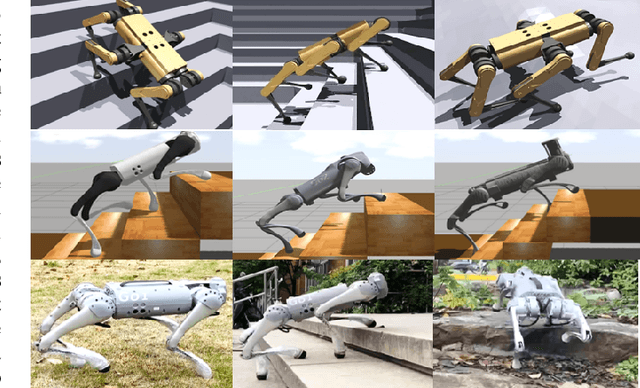
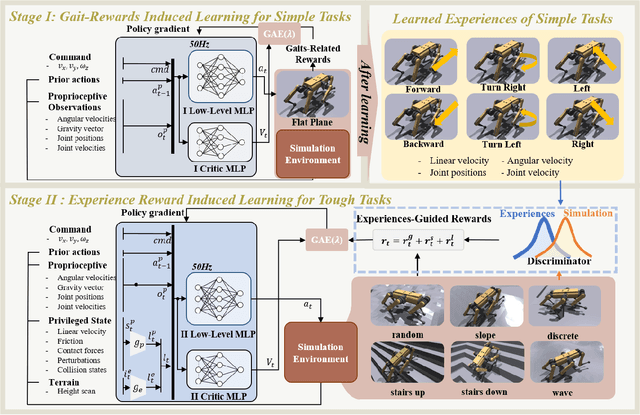
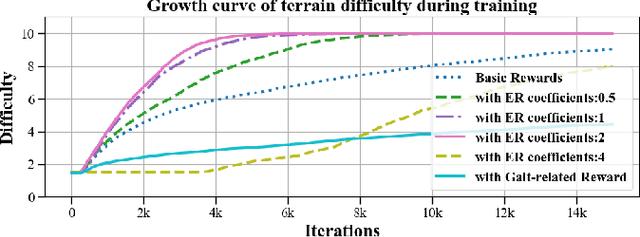
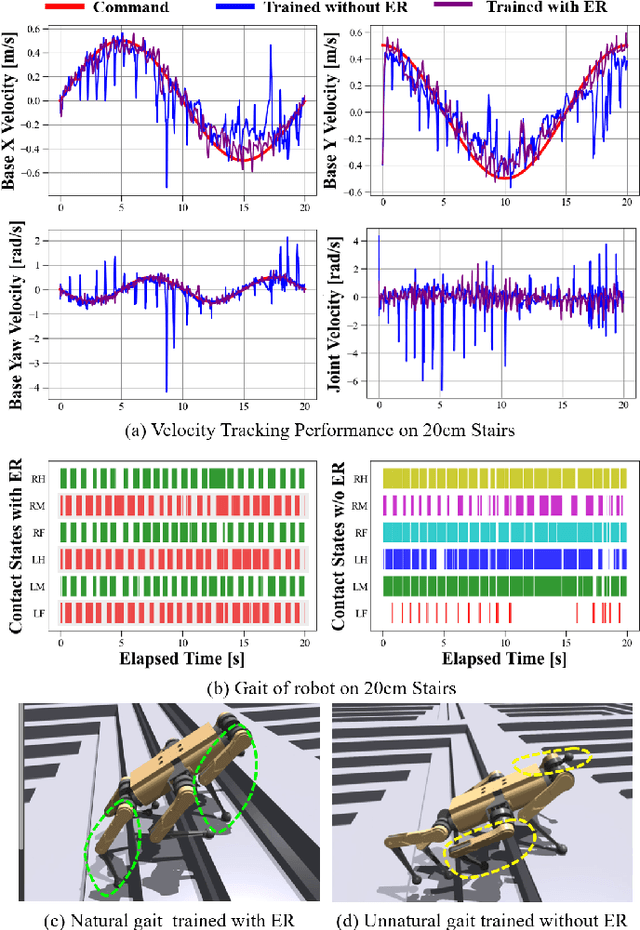
Multi-legged robots offer enhanced stability in complex terrains, yet autonomously learning natural and robust motions in such environments remains challenging. Drawing inspiration from animals' progressive learning patterns, from simple to complex tasks, we introduce a universal two-stage learning framework with two-step reward setting based on self-acquired experience, which efficiently enables legged robots to incrementally learn natural and robust movements. In the first stage, robots learn through gait-related rewards to track velocity on flat terrain, acquiring natural, robust movements and generating effective motion experience data. In the second stage, mirroring animal learning from existing experiences, robots learn to navigate challenging terrains with natural and robust movements using adversarial imitation learning. To demonstrate our method's efficacy, we trained both quadruped robots and a hexapod robot, and the policy were successfully transferred to a physical quadruped robot GO1, which exhibited natural gait patterns and remarkable robustness in various terrains.
Swing Leg Motion Strategy for Heavy-load Legged Robot Based on Force Sensing
Sep 03, 2023The heavy-load legged robot has strong load carrying capacity and can adapt to various unstructured terrains. But the large weight results in higher requirements for motion stability and environmental perception ability. In order to utilize force sensing information to improve its motion performance, in this paper, we propose a finite state machine model for the swing leg in the static gait by imitating the movement of the elephant. Based on the presence or absence of additional terrain information, different trajectory planning strategies are provided for the swing leg to enhance the success rate of stepping and save energy. The experimental results on a novel quadruped robot show that our method has strong robustness and can enable heavy-load legged robots to pass through various complex terrains autonomously and smoothly.